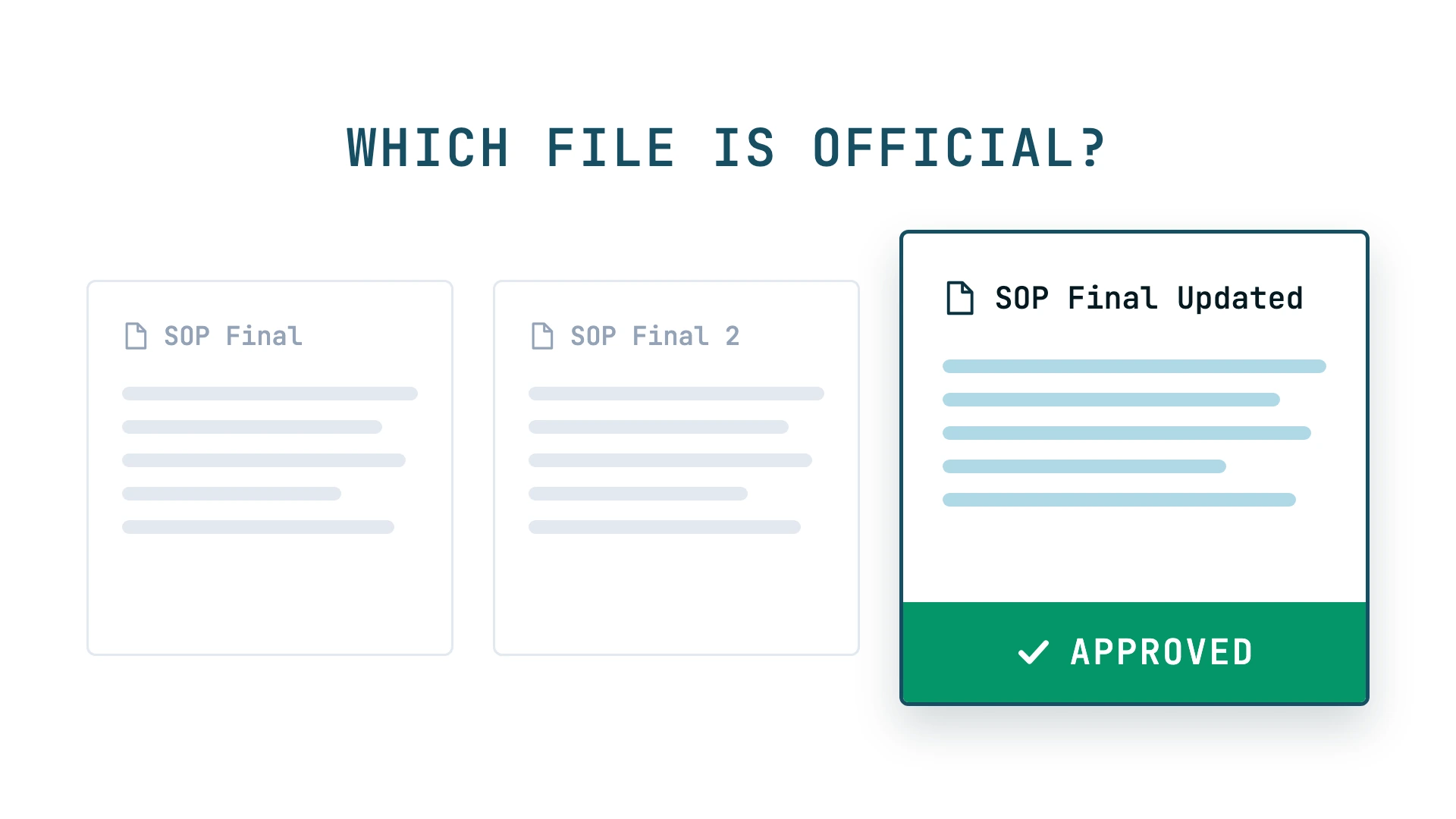
Google Drive automation
Google Drive Automation Needs Document Control
Google Drive automation can help AI find company information, but without document control, it may give your team the wrong file. Learn how to fix it.
6 min read
Read articleInsights
Articles on reducing turnaround times, preventing errors, increasing capacity, and choosing software, automation, or AI based on the problem.
Google Drive automation can help AI find company information, but without document control, it may give your team the wrong file. Learn how to fix it.

See how AI workflow automation helps teams sort incoming messages, prioritise work, and keep sensitive business decisions under human control.

Your bookkeeping shouldn’t depend on who’s working. See how an automated bookkeeping workflow creates greater consistency and long-term sustainability.
Google Drive automation can help AI find company information, but without document control, it may give your team the wrong file. Learn how to fix it.
See how AI workflow automation helps teams sort incoming messages, prioritise work, and keep sensitive business decisions under human control.
Your bookkeeping shouldn’t depend on who’s working. See how an automated bookkeeping workflow creates greater consistency and long-term sustainability.

More context does not always improve AI performance. Learn how LLM context length affects reliability and how to use long-context AI effectively.

A practical learning path through prompt engineering roadmaps, model-specific guides, Claude Code practices, and context engineering.
Start RAG retrieval with recursive or sentence-based splitting, then use evaluation results to decide whether semantic chunking is worth the cost.
Compare managed, self-hosted, colocated, and air-gapped options for moving speech-to-text and text-to-speech workloads to Australia.
Compare LangChain with provider SDKs to decide when framework abstractions help an AI chatbot and when direct code is easier to maintain.

Detect positional bias and ranking cycles in pairwise LLM judges, then use balanced comparisons to improve evaluator reliability.
Voice interfaces face structural limits involving memory, precision, privacy, and error recovery even as speech models improve.

Compare models, GPUs, providers, latency, and costs for hosting a production sovereign voice AI inference stack in Australia.
Learn why pairwise ranking gives more useful LLM evaluation results than numeric scoring, and how to infer relative quality.
Compare CLI tools and MCP servers for AI agents across token use, context cost, reliability, security, and developer experience.
Turn subject matter expert feedback into reusable evaluation criteria, durable knowledge, and faster AI system improvement loops.

Use deterministic routing, explicit agent skills, and evals to stop AI agents from confidently selecting the wrong workflow.
How a generate, evaluate, and revise loop improves LLM output by turning clear acceptance criteria into useful feedback.
Learn how logit bias can reduce repetitive AI writing patterns, where it fails, and how to test it without causing token loops.

Use the RED framework to make binary LLM evaluations explain their reasoning, cite evidence, and return a clear decision.
How a standalone hexagonal grid system creates procedural faction territories for a role-playing game through deterministic algorithmic expansion.
A practical guide to building a basic evaluation system for non-deterministic AI applications using LLMs and prompt engineering.
Discussing the limitations of traditional PERT and introducing my personal project estimation tool, Wagn Project Tracker, which uses a certainty-based approach.
Lessons from building a React voice interface library, including audio recording, streaming, and WebSocket transport for real-time conversations.
Lessons from building real-time AI chatbots with streaming responses, covering latency, state, error handling, and user experience.
How mature web frameworks converge on the same capabilities, and why AI may shift software value from framework expertise to problem solving.
Samification is the process where competing technologies, frameworks, or ideas gradually converge toward a single, widely accepted standard.
Learn how canonical naming defines entity boundaries in Retrieval-Augmented Generation and knowledge graphs, improving retrieval and reasoning.
Learn how vector embeddings represent meaning, support semantic search, and retrieve related content for RAG and AI applications.
Learn how Model Context Protocol connects AI agents to external tools and data, what MCP standardises, and where it fits compared with a CLI.
Retrieval-Augmented Generation (RAG) is a technique that enhances AI-generated responses by first retrieving relevant information before generating an answer.
Why static sites suit durable knowledge bases: fast publishing, low operational complexity, and clear internal linking for people and search engines.
Vibe coding uses natural-language instructions and LLMs to build software, changing how people prototype, debug, and learn application architecture.
How AI voice cloning changes phone security, and the practical caller-verification controls that reduce impersonation and fraud risk.